Paradox: Gritty Faith (or Holding on Like a Woman Wrestling a Wet Cat)

Summer has bled into fall and school started around these parts last week. I meant to share more of my shiny spring paradox stockpile this summer. If you’re thinking to yourself, “well, isn’t it September?” You’re correct. Writing move slow for this magpie.

A white bowl filled with fresh, ripe red strawberries, some with green stems, on a wooden surface.

And really, the changing season is what’s prompted this essay. In the midst of the kids starting school, I have tried drumming up excitement. I’ve even been moderately successful in this endeavor during socially necessary moments! Yippy for putting more marbles in the “good job for not making it weird” jar! But since this is a safe place, can I go ahead and make it weird? Because, between you and me, rather than excitement, I’ve been mostly feeling melancholy.

Summer was fine, not “the best thing ever!” not “the worst thing ever.” We are all ready for school. So, while I don’t not want summer to end, and while I don’t not want school to start and I do want to be content with life and looking forward to the year, I’m feeling sad and..is that guilt?

Why, now that I’m talking about it, I think I’m channeling my inner middle-school tween self. Feeling a bit awkward and sweaty. Bangs, braces and fruity perfume. Now that I’ve realized this, I’m trying to remind myself that “all feelings and parts of myself are welcome,” in the spirit of, “if I say it enough, I will begin to believe it’s true.”1 (Check back in a couple weeks to see if it worked…So far, still feeling uncomfortably angsty.) But this brings us to why September is a good time for this little essay on paradox. Specifically, the Stockdale Paradox. I’d heard about Stockdale before, and was reintroduced this spring on Brene Brown and Adam Grant’s Podcast — the Curiosity Shop.

Admiral Jim Stockdale was a Vietnam vet and war prisoner who survived EIGHT YEARS as a POW. Jim Collins recounts a conversation he had with Stockdale in the book, From Good to Great. He asked Admiral Stockdale how he survived those eight years in Vietnam as a prisoner:

Admiral Jim Stockdale, [] was the highest-ranking United States military officer in the “Hanoi Hilton” prisoner-of-war camp during the height of the Vietnam War. Tortured over twenty times during his eight-year imprisonment from 1965 to 1973, Stockdale lived out the war without any prisoner’s rights, no set release date, and no certainty as to whether he would even survive to see his family again. …

“I never lost faith in the end of the story,” he said, when I asked him. “I never doubted not only that I would get out, but also that I would prevail in the end and turn the experience into the defining event of my life, which, in retrospect, I would not trade.”

I didn’t say anything for many minutes, and we continued the slow walk toward the faculty club, Stockdale limping and arc-swinging his stiff leg that had never fully recovered from repeated torture. Finally, after about a hundred meters of silence, I asked, “Who didn’t make it out?”

“Oh, that’s easy,” he said. “The optimists.”

“The optimists? I don’t understand,” I said, now completely confused, given what he’d said a hundred meters earlier.

“The optimists. Oh, they were the ones who said, ‘We’re going to be out by Christmas.’ And Christmas would come, and Christmas would go. Then they’d say, ‘We’re going to be out by Easter.’ And Easter would come, and Easter would go. And then Thanksgiving, and then it would be Christmas again. And they died of a broken heart.”

Another long pause, and more walking. Then he turned to me and said, “This is a very important lesson. You must never confuse faith that you will prevail in the end—which you can never afford to lose—with the discipline to confront the most brutal facts of your current reality, whatever they might be.” (https://www.jimcollins.com/concepts/Stockdale-Concept.html accessed May 29, 2026; emphasis added).

Certainly, my life is nothing like being in a Vietnam POW. However there is wisdom here for even those of us with only #firstworldproblems.

Two things can be true.

You can have faith and face brutal facts.2

You can be happy and sad.

Things can be hard and good.

Life is riddled with heartbreak and God is ushering in wholeness.

A close-up of a red sunflower with a bee collecting nectar from the center, surrounded by green foliage.

What I’m saying is that I’m looking at my current mixed bag of feelings including how I want to feel–trying to both acknowledge the mixed bag and hold onto the faith that Jesus is even now ushering in His kingdom of wholeness in glory. I’m holding3 onto the whole Pauline idea that “suffering [even if suffering ‘only’ in my own mind] produces perseverance, perseverance, hope and hope does not disappoint us.”

I’m reminding myself, many times a day that, when James advises us to “consider pure joy” those “trials of many kinds,” he means: (a) even those trials simply in our own brains; (b) they are pure joy because “the testing of your faith produces perseverance and perseverance does not disappoint because God has poured out his love into our hearts through Christ Jesus;” and (c) he wasn’t just blowing smoke -this is what happens. When we surrender our grip and give God the space, He uses *all* the suffering and trials to carve us into people of character.

So.

Admiral Stockdale’s paradox bears repeating: “You must never confuse faith that you will prevail in the end–which you can never afford to lose–with the discipline to confront the most brutal facts of your current reality, whatever they might be.” Gritty faith. Bathe the cat.

  1. Nate Bargatze is right. This is what scientists are saying about our brains. ↩︎
  2. Brown and Grant call it “gritty faith.” I say yes and amen. ↩︎
  3. And, by “holding,” please imagine a person attempting to wrestle a slippery wet cat back into the bathtub to rinse off the soap. That’s what I mean by “holding.” ↩︎

The Mid-Life Paradox (Or, on Parenting Teenagers)

Since April, every time I turn around, I’ve been running headlong into one end or another of the same intractable paradox while stumbling upon the actual word “paradox” and what some philosopher, theologian or researcher has to say about yet another paradox.

Paradox was not my word for the year. I’m over here anyway, repeatedly bruising myself against this emphatically mid-life paradox and, like a magpie, hoarding references to every other paradox I happen on. Maybe one of these shiny paradoxes will unlock the secret to what ails me?

My bruised soul sure hopes so.

The contours of the mid-life paradox that I keep stubbing my toes on are this: I know as much about life as I’ve ever known, but the more I learn, the more I recognize that there is still SO MUCH I haven’t figured out. And. I’m simultaneously over here attempting to manage my teenage offspring realizing, deep in the marrow of my bones, that I know so much more than my kids. So. Much. More. 

In short my midlife paradox1 is just that: knowing so much, understanding it’s so little, and concurrently realizing I absolutely know significantly more than my spawn who act as though they actually know everything and know very little. 

Now, ok. I always knew that I know more than my kids. When they were babies they didn’t know anything. Babies maybe don’t even know why they’re crying, just that something’s wrong. So they cry.

And then you teach them and help them every single day for years and years with all kinds of tasks. Essential human tasks (from how to use a spoon to how to wipe their own behind) and more abstract-concrete things like reading, writing, arithmetic and then even more abstract things…philosophy, ideas, time management… And as a Christian2, I’ve gone around and around trying to teach my kids about Jesus. Attempting to introduce them to Jesus, really. Yeah. I like thinking of Christian discipleship in terms of introducing my kids to Jesus.3 It sounds noble, but my implementation of this goal has been humble, at best.

In fact, as they’ve grown, the sweet lessons I would pat myself on the back for having taught them — the obvious life lessons I’d underline for them, the kinds of things that I would regularly write about on the internet — well, they’ve come to feel like moralizing. Sermonizing. And I’m not sure of the “results.”

So I’ve been over here on the East side of Kalispell intermittently trying to introduce my kids to an invisible God who put on flesh … who walked the earth in a time and culture that I don’t understand very well… who said and did a great number of things that I can’t explain very well…who left a collection of writings ranging from ancient to extremely ancient explaining His plan for humanity4…and how I can interpret it all to make suggestions for how it might apply to the specifics in my kids’ lives when life is messy and sometimes painful and confusing.

When I put it like that, it’s no wonder I’m having trouble making sense to the kids. I’m overcomplicating things. I can’t help it.

Lest you imagine my life as a stay-at-home, homeschool mom in terms of someone else’s beautiful Instagram page, please picture our reality: a middle-aged woman in small-town Montana, burned out from practicing law, bad at keeping the house, regularly taking a nap in the middle of the “homeschool” day because she can’t drum up the patience to deal with getting the younger two through their literature5 after accidentally reverting to a shrill 17-year-old version of herself whilst trying to get a handle on where the eldest wants to drive to, who she’ll be with, for how long, and whether everyone’s partaken of too much technology today.

Yeah, I’ve been trying to introduce my kids to Jesus but I don’t yet live enough like Him to feel adequate to the task. And even the little I do have a handle on seems to fall flat or otherwise be lost in translation. (Feel free to ask my teenagers about how “unfair” and “restrictive” we are and witness the giant eye-rolls as I attempt to dispense my actual wisdom…Will they rebel because we’ve set boundaries in the wrong places? Have we failed to provide a safe space for them to bring their feelings and problems? Do I actually cave too much? Am I too inconsistent?)

This is the backdrop for my mid-life paradox. And yet. It’s not all I know, this floundering as I parent teens.

Cushioning the impact of all my running into the edges of the mid-life paradox is His abiding Grace. I used to have all.this.angst about whether God exists and whether Jesus’ claims about Himself were true. I counterbalanced my Angst6 with earnestness and certainty. When I had moments of sheer existential terror that I didn’t *know* whether God was real, I would study harder, pray more and attempt to persuade all the people of the authenticy of my faith.

I realized not too long ago that sometime in the last 5ish years, this Angst has dissolved. In its place is a knowledge that I feel in my body that God sees the world’s turmoil, feels our individual aches and pains and sent Jesus to redeem us. I have experienced times where I know in the marrow of my bones that this ancient-yet-present Yahweh of the Bible was feeling with me the sad things and sometimes, I’ve experienced circumstances where He’s smiling at me with a twinkle of delight.

With the loss of the Angst, I’ve also lost my earnestness and certainty. I’m ambivalent about whether this has been a good exchange. I enjoy the lack of existential Angst and I certainly enjoy the abiding existential peace, but, here I am parenting teenagers and don’t teenagers respond to earnestness? Certainty? I just can’t with the earnestness and certainty anymore. I don’t know what God’s playing at here.

So, I long for a tidy lesson I can apply to parenting teenagers and give to people with three action steps. But, I can’t pin any down. All I can tell them is that I’m a middle-aged mom raising teenagers who has the life experience to know a lot of things, the wisdom to know there are that many more things she doesn’t know while simultaneously knowing she knows SO MUCH MORE than her kids.

In the months I’ve been struggling to finish this essay, casting about for a closing in the midst of unseemly ambiguity, I happened upon one of my teen’s willful flirtation with a sin that is firmly labeled in my mind: “if allowed to fully grow can blow up your life.7“

Once again, I addressed the issue with said teen who deflected and rationalized, “Mom, it could be so much worse.” Right. I exclaimed, somewhat tearfully, “it hurts my heart that you are continuing to be unwise in this area of your life. I feel no peace about this.”

Cue the rolling of eyes and stonewall.

We continued the evening and, as a family before bed a bit later, we prayed. It got to this teen’s turn and said child interceded as follows: “Jesus, please help Mom with her anxiety. Help her trust in You, like pastor talked about today, You take care of the sparrows and lillies. She doesn’t have to worry.”8

I don’t have answers to the persistent questions of how to raise teenagers. I have no tips or tricks.

But. What I can confidently testify to is this: after this kids’ supercilious prayer for me, my anxiety has decreased significantly. Apparently, there is power in prayer. (And, this whole situation that night was God, once again winking at me).

  1. Or is it my mid-life crises … both/and? mid-life criradox, paracris? paradoxises? I’d coin them all! ↩︎
  2. I feel like adding a modifier here to explain…born-again Christian?, evangelical Christian?, Jesus-follower?, Jesus apprentice?…None of these is quite right, but not all wrong, either. See? I know that I don’t know….Mid-life paradox. ↩︎
  3. I could get really in the weeds here and say, “apprentice” to Jesus, as John Mark Comer has helped us understand the goal of Christian life. This feels pretentious for me to talk about, particularly in light of how things have been going this summer. So, I’ll leave it at “disciple,” even though “apprentice” makes much more sense to my 21st century self. ↩︎
  4. Tell me your an Enneagram 6 wing 5 without telling me your an Enneagram 6 wing 5 😉 ↩︎
  5. Yes, it’s currently August and no, we aren’t doing literature in August. I started this post in May when we were still doing literature. Sorry for the delay. ↩︎
  6. Yes, it was Angst with a capital “A” ↩︎
  7. This teen has not blown up their life. This teen is amazing. But the potential they might blow up their life wakes me in the middle of the night. Clearly, my Angst has morphed into parental angst. ↩︎
  8. Did it take everything in me at that moment to not laugh, cry, tear my hair out and strangle this teenager? Why, yes. I’m chalking up my heroic non-response to Jesus’ continuing sanctifying work in my life. ↩︎

Transforming Thoughts on the River

Deep calls to deep in the roar of your waterfalls; all your waves and breakers have swept over me. (Psalm 42:7)

They flow, curving through Northwest Montana.

The North Fork, Middle Fork, South Fork.  Swan. Whitefish. I most appreciate these rivers in late July. August, if the smoke hasn’t settled in like a thick, wool blanket.

The hot sun bakes my shoulders. Sweat trickles down my back. My eyes blink, squinting in the sudden brightness as I step out from the dappled darkness of the trees to the rocky “beach.” Thorns and bushes scratch my legs and my feet twist, walking over flat, large stones. This place was riverbed not two months ago.

An old favorite chorus at church growing up proclaimed, “I’ve got a river of life, flowing out of me. It makes the lame to walk and the blind to see. Opens prison doors sets the captives free. I’ve got a river of life flowing out of me. Spring up a well!”

How freely does that river flow through me now? Have I somehow dammed it, leaving only a trickle?

I tuck the thought away. 

Deep, slow breath.  It smells cooler here, immediately next to the river. I smile, it always does.  My baseball hat feels like a winter stocking cap. Now sweat drips between my brows, furrowed as I squint. It is sweltering.

Still, I hesitate at the edge of the water. The rushing, constant roar of the water muffles the little voices behind me.

A step.  The initial shock of icy cold is unpleasant, 90 degree heat and all. I always have to pluck up my nerve.

Another thought surfaces:  The kids were babies.  Yesterday, wasn’t it?  We were bleary-eyed.  Arms locked in a clutching position.  Our voices gentle, babbling noises and delighted smiles.  Shhh and da-da-da-da.  Repeating words with delight – “leaf” “rock” “river!”

It carries us. 

I have been trying to grasp and hold.  Slow it.  Stop it.   Sometimes I feel like Bill Murray in Groundhog’s Day.  Waking every morning to the same everything…mind-numbing, monotony.  But then it rushes by, dizzying.  When did my oldest spring up, nearly as tall as me? There are no toddlers or babies in the house anymore.

I cannot control how it flows.  We are out here in the middle, being carried forward.  We can’t go back upstream.  We can only position ourselves to navigate what’s ahead.

I realize that my feet and shins are now comfortable.  I am exactly the right temperature.  Red, brown and grey rocks are clearly visible beneath the clear water.  It’s low today.  Shallow. 

A yellow leaf floats past.

The red raft drops next to me.  Half ashore, half bobbing in the current.  Sides streaked with grey mud.  The kids shriek as they splash into the water, too.  The littlest slips on a rock, barely keeping his balance.

Jesus’ words to the woman at the well now rise to the surface of my mind, “whoever drinks the water I give him will never thirst.   Indeed, the water I give him will become in him a spring of water welling up to eternal life.” 

We climb aboard.  One paddle per person.  He shoves the raft out from shore, holding it momentarily from drifting downstream as he swings his legs over the side.  We’re off!  Slowly following the leaf downstream.

Ahead, the water spits and churns.  “Everybody paddle!”  Our paddling is uneven, adults on one side, kids on  the other.  The raft responds, turning to the left.  For several moments we head toward the spitting, churning section sideways.  From the back, Kagan dips his oar a few times and we right.   Nose forward we now squarely face the “rapids”.

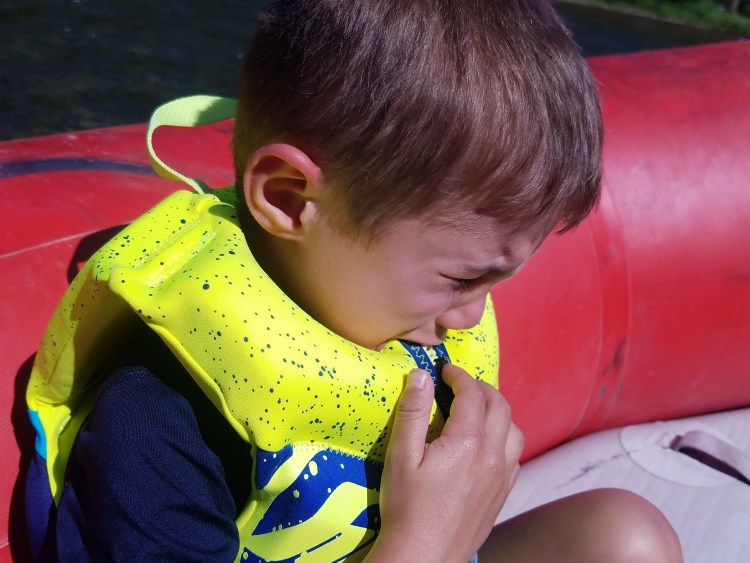
The boat jerks violently several times.  The youngest begins to cry.  He huddles in the bottom of the raft, chewing on his life vest. 

Minutes pass.  We now face only a long stretch.  We are moving swiftly, but there are no more bumps to face.  I attempt comfort.  The illusion of safety has been lost.  He is impervious to my assurances.

I think of the disciples, long ago on the sea of Galilee.  Grizzled fishermen terrified by a powerful storm. Jesus, sleeping in the boat. 

Half an hour later, our youngest child’s continued crying is now under my skin.  It feels like a splinter, uncomfortable and annoying.  It’s self-indulgent.  Sharp words rise to my tongue.  As they begin for form, I feel a nudge in my spirit. 

“You can be very like him, Becky.” 

The sharp words evaporate before I release them.

In life, I am swept in the current.  I am tossed and jostled and dropped in the rapids.   I have fastened my life preserver.  I clutch my oar. But, just like this little one, like those disciples, at times I find myself huddling in the bottom of the boat.  Eyes screwed shut against the sun and scenery, ignoring the Parent who rides with me.

At those times, terrified questions leak from me:  “what’s next?”  “Remember that trouble!?!” 

Our raft floats to the edge of the river, now caught in an eddy, gently turning.  The crying continues.  So do my thoughts.  We paddle, just one side, and the raft turns another circle.

I find my thought swirling, too.  “I’ll always be like this” “Who do I think I am?” “It’s already too late…”  Vivid embarrassment, guilt and shame from past failures color the thoughts and the circles are no longer lazy, but frenetic.  All that remains now is those feelings.

A new thought pierces the barrage.  The oar of Scripture gently slows the swirling:

“Being confident of this, that He who began a good work in you will carry it on to completion.”  (Philippians 1:6).  My ineptitude will not defeat God’s good work.

“The Counselor, the Holy spirit, whom  the Father [has] sent will teach you all things and will remind you of everything I have said to you.”  (John 14:26).  I will not forget.  I will hear.  I will see.  I will proclaim.

The Spirit carries us along. Jesus knows what rapids lay ahead.  Those rapids I did not anticipate yesterday?  They were no surprise to Him. He positions me to navigate.  He gives me the oar and guides my strokes. 

We paddle on one side, then the other.  Our arms burn slightly with the effort.  It’s work.  Forward  motion now. 

The boat noses back into the current, and begins again downstream.

It’s slow now, barely moving.  The littlest one’s tears have slowed, but he is still huddled there in the bottom of the raft, clenching his life vest for security.  His big brother jumps off the side of the boat with a shriek of delight.  Cool water splashes us. I laugh at his joy. 

I remember Paul’s words, “where the Spirit of the Lord is, there is freedom.  And we, who with unveiled faces all reflect the Lord’s glory, are being transformed into his likeness with every-increasing glory, which comes from the Lord, who is the Spirit.”  (2 Cor. 3:17-18).

The youngest looks up.  His sister offers him cherry, her own teeth stained with the juice.  Conflicted for a moment, his desire for one of his favorite fruits wins out and he lets go of his vest to take it.  Soon, he is reaching for more with both hands.

He might have fun yet. I think I will, too.

You?

Sign up here for the free download, “where the Spirit of the Lord is, there is freedom.”

Work in Progress

Quiet morning, busy week.

Feeling the pressure mounting and experiencing every of minor thing gone wrong as particularly annoying.

Dishwasher? Still broken. Printer? Offline. Kids? Bickering.

Anybody else facing challenges these next few days?

The mix of challenges is as different as we are. Personally, I found myself rushing home hungry to a house of tired kids, thinking of the work I didn’t *quite* get to finish, vaguely anxious about the logistics of traveling by plane Wednesday (should I try to carry on all my luggage? will all those 3 ring binders fit? do I have travel-size shampoo?).

I caught myself yelling, “STOP YELLING!” at the kids the other night. Shockingly, it did not stop the yelling and about the second time, I yelled my directive, I realized that my modeling on the issue was leaving something to be desired.

We all desperately need a reset at times, don’t we?

When we find ourselves yelling or avoiding or ignoring or whatever our particular “tell” is, let’s take a deep breath. Right when we realize it.

Then, let’s remind ourselves: when our time, energy, patience and smarts just aren’t enough, it is there Jesus shines through all the more. Friend, we still have to show up, we still might have to bite our tongue, or talk when we would rather pretend we weren’t actually present…Yes, yes. But the first step of faith, friend, is stopping in our tracks right then to listen to Him speak over us, “my grace is sufficient for you, for my power is made perfect in weakness.” (1 Cor. 12:8).

The power of the “the image of the invisible God, the firstborn over all creation. [Who] is before all things and in [Whom] all things hold together.” (Col. 1:15, 17) gives us His power in our weakness so His glory is shown.

That’s the next step of faith: showing up, with this belief in hand, giving it our best, and surrendering to Him the results.

Easier said than done, I know. So let’s breath Him in deep and encourage each other — His power is perfected in our weaknesses and He is more than enough.

Lessons from a Broken Dishwasher

Monday night, we finally admitted that the dishwasher is broken. Over the last several months, we’d been noticing our bowls weren’t *quite* clean when the kids went to unload them. We made adjustments in our loading and rinsing, but there was no corresponding positive adjustment in the cleanliness of our dishes.

I — in typical pragmatic laziness — decided that although there were teeny flecks of food on the bowls after washing, the heat cycle of the dishwasher surely sanitized everything adequately. So, we persisted in use. Over the weeks, the bowls became flecked with larger food particles. The garbage disposal quit working. We could stand it no longer.

We pulled up a YouTube video and began poking around the disposal. And then the dishwasher. We came to realize that we needed a professional. I called the professional, and they will arrive to *hopefully* repair the dishwasher on Tuesday. So we have been washing all our plates, bowls, cups and utensils by hand since Monday.

It’s not life-changing. It’s a first-world problem. It’s annoying and frustrating all the same. And, it’s been a good reminder. For some reason, in the age of technology, we think that we can find the answers ourselves. No need for experts. No need for professionals. At times, we believe that we are omniscient. If we are savvy enough with our internet research, we can know all things.

We also seem to think that we are omnipotent. Since we can know all things, we should have the power to fix all things. Our marriages. Our kids. Our parents.

Except, my broken dishwasher. And my broken disposal.

Part of faith, I’m learning, is admitting that, although I could probably know more, I am not held to the omnipotent standard. Part of faith, too, is trusting that I can’t do it all. Although the information is out there and we could probably fix this or that, God does not expect us to be omniscient or omnipotent. He’ll do that part, and take all the broken things and make them beautiful in His time.

Go ahead, call the Professional. Wait for Him to arrive, and trust His expertise.